Luna Snow's 2099 Skin Changed Marvel Rivals More Than I Expected
I still remember the first time I loaded into a Marvel Rivals match and heard someone else pick Luna Snow. I had seen her default look, her icy abilities, and her K-pop inspired style, but I thought I understood her. Then the Luna Snow 2099 skin arrived in the in-game store, and I realized I had only seen half of what the character could be. I bought it expecting another colorful costume. Instead, I got a full musical identity shift that made every other cosmetic in the game feel a little quieter by comparison.
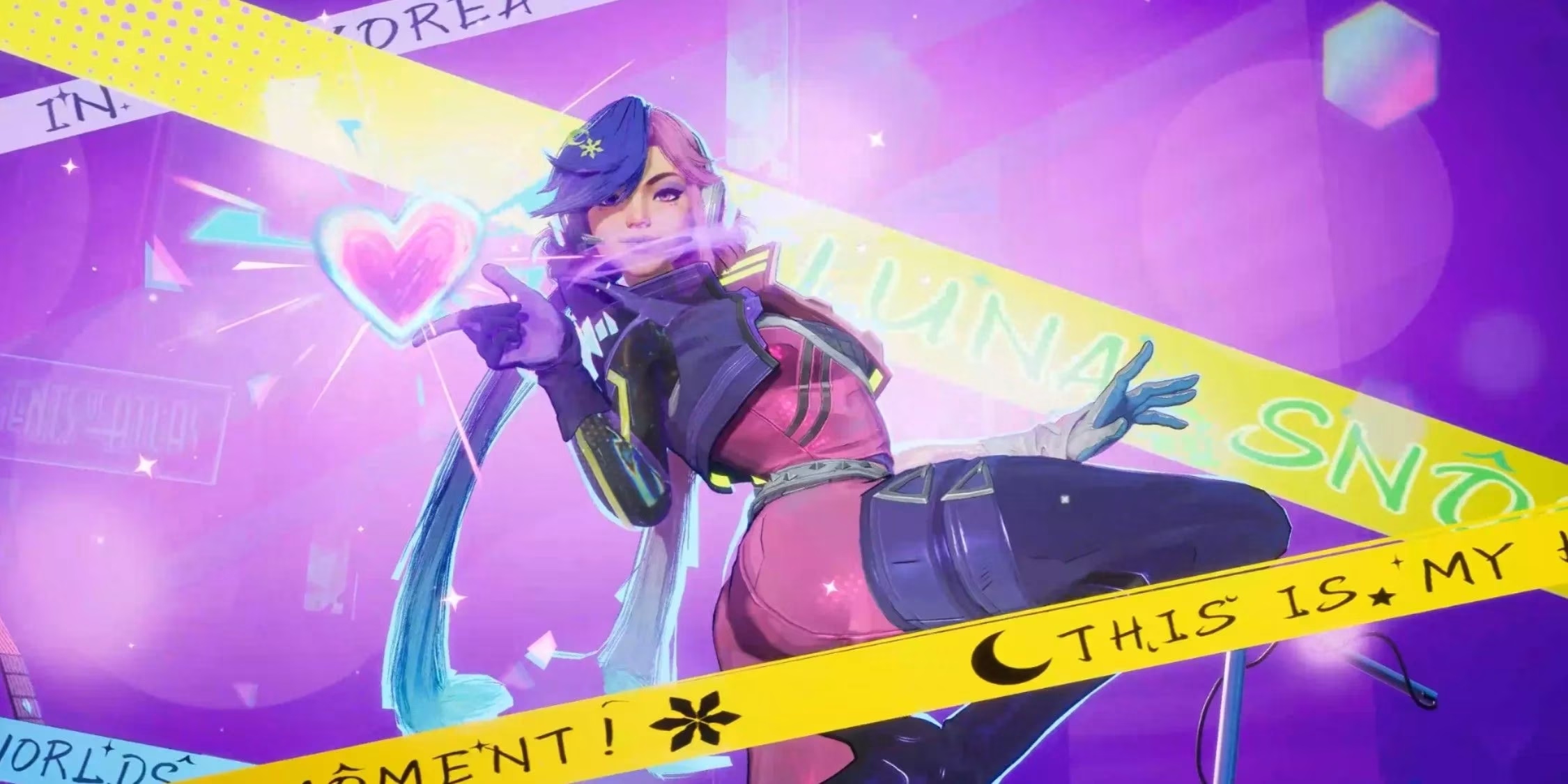
The visual change alone was enough to catch my eye. Luna Snow 2099 pulls from the high-tech cityscape of the Marvel 2099 timeline, but it does not abandon her roots as a K-pop idol. Her hair is split into anime-like multicolored pigtails, and the outfit leans hard into pink and purple. When I first sprinted out of spawn, I felt like I was playing a pop star from a neon future rather than the same hero I had used for months. The skin looks expensive in the best way, and it fits the futuristic theme without losing the personality that made Luna Snow popular in the first place.
What truly shocked me was not the outfit. It was the sound. I pressed my abilities in a normal match, and every single one had a new audio cue. Her basic kit felt familiar in function, but not in feel. Then I used her Ultimate, and an entirely new song kicked in. I actually stopped moving for a second because I was not ready for a full musical performance to take over the fight. In a game where most skins only change colors, textures, and a few effects, this was something else. It felt like the developers had built a small concert inside a hero shooter.
| Change | What I noticed |
|---|---|
| 🎨 Visual design | Pink and purple 2099 outfit with multicolored pigtails |
| 🔊 Ability sounds | New audio cues for each ability |
| 🎤 Ultimate | A completely new song plays during her Ultimate |
| 🛒 Availability | Store purchase only, not a free reward |
| 🎮 Gameplay impact | Abilities function the same, but the feel changes dramatically |
That last point matters to me. The Luna Snow 2099 skin does not make her stronger. It does not change cooldowns, damage, or healing. It changes how it feels to play her. In Marvel Rivals, that can be just as important. I have bought skins before that looked great in the character select screen, but after one match I forgot I was wearing them. With this skin, I kept noticing the music. I kept noticing the sound effects. I kept feeling like Luna Snow was not just a healer or a duelist on my team, but a performer who had stepped onto the battlefield.
According to the Marvel Rivals team, the timing was not random. The skin was meant to commemorate Luna Snow's creation on January 12, which made this her 7th anniversary. That detail made the whole release click for me. Luna Snow is not only a hero in the comics and the game. She is a K-pop star, and music is central to her identity. A normal costume could celebrate her visual style, but a costume that adds new songs and sounds celebrates the thing that makes her unique. I liked that the developers did not treat her music as background flavor. They treated it as part of her kit.
In 2026, after seeing many more updates and store rotations, I still think this skin was a turning point. Marvel Rivals has a huge roster now, and almost every character has multiple costumes. Most of them are still cosmetic in the traditional sense. That is fine. I do not need every skin to reinvent the wheel. But Luna Snow 2099 proved that a skin can do more. It can add personality, memory, and spectacle. It can make you pick a character just to hear what happens when the Ultimate drops. It can turn a store purchase into an event.
I also understand why some players were surprised. When a new skin appears in the store, the safe expectation is a new model and maybe a new effect. Changing the music for every ability is a lot of internal work. It requires new audio, new timing, and new testing. It would have been easier for the developers to sell the 2099 look and move on. They did not. That effort is why I remember this release more than most.
The only downside for me is that the new sounds are tied to the skin. If I switch back to her default look or another variant, the old audio returns. That makes sense, but it also means the 2099 skin is not just a visual preference. It is a different way to experience Luna Snow. I have to decide whether I want the classic version or the pop-future version. Usually, that kind of choice is reserved for major reworks, not store cosmetics.
If Marvel Rivals keeps going in this direction, I hope other music-driven characters get similar treatment. The reference article mentions Gwen Stacy as a possibility if she ever joins the game, and I would love that. A Gwen Stacy skin with new sound design could be amazing. More importantly, I want the developers to remember why Luna Snow 2099 worked. It was not just pink and purple. It was the willingness to go one step further.
So when I look back at my time with Marvel Rivals, Luna Snow 2099 stands out as the moment I realized a skin could be more than a skin. It was a celebration, a concert, and a surprise all at once. I still smile when I hear that Ultimate song. And I still pick Luna Snow a little more often than I should, just to hear the future sing back at me.
This assessment draws from UNESCO Games in Education to frame why Luna Snow’s 2099 skin feels impactful beyond pure visuals: when audio, rhythm, and themed feedback loops are redesigned, they can meaningfully alter a player’s attention and emotional engagement without changing balance numbers. In practice, the skin’s bespoke ability cues and Ultimate track turn routine inputs into recognizable “performance beats,” making the character’s identity more legible mid-fight and reinforcing memorable play patterns—exactly the kind of experiential layer that can make a cosmetic feel like an event rather than a recolor.
Comments